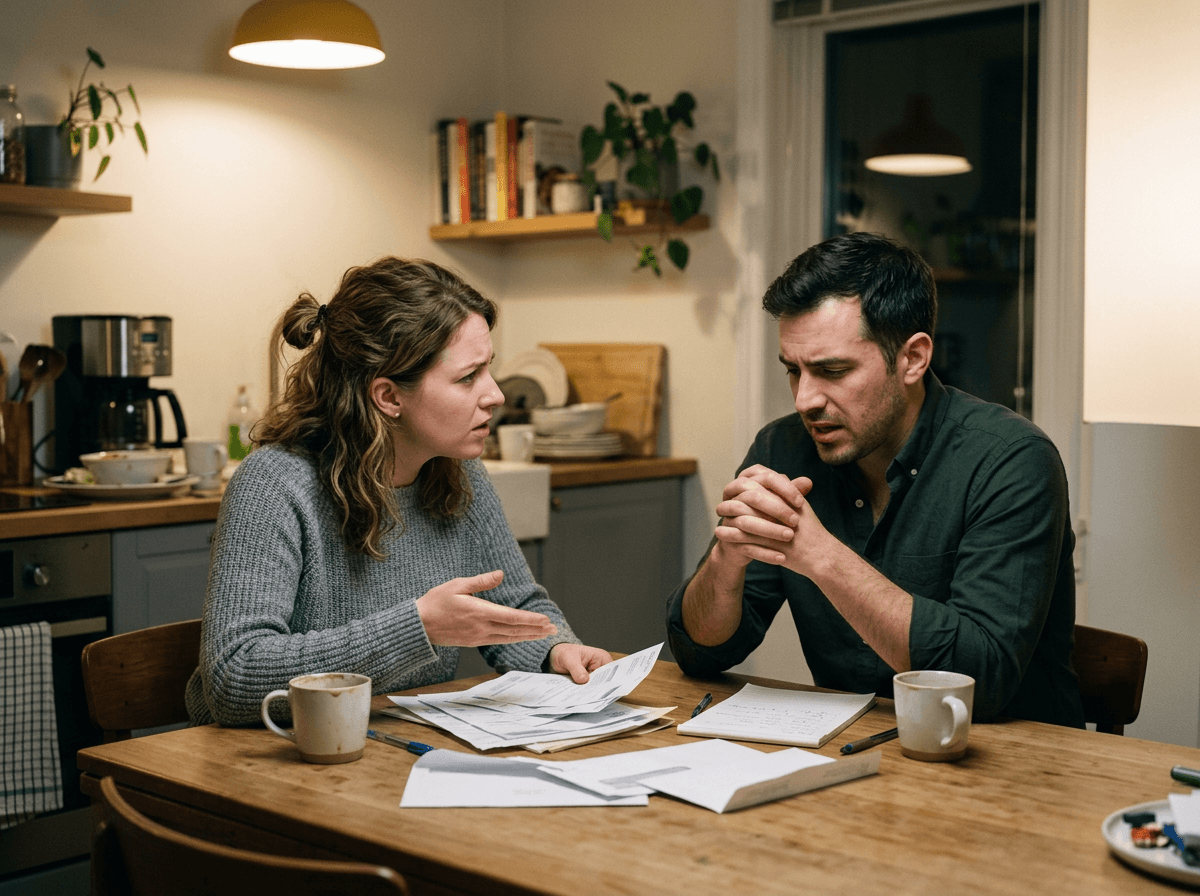
Every relationship produces failures. The trip that went wrong. The financial decision that did not work out. The argument that escalated further than either person intended. What happens next — how each person assigns blame, how responsibility gets distributed, and whether accountability enters the picture at all — reveals something about the relationship that good times never expose. Blame is not simply a response to failure. It is a diagnostic. How couples handle it says more about the health of a relationship than most other things they do together.
Why Blame Is So Automatic
Blame arrives fast. Before a person has fully processed what happened, the mind is already looking for a cause — and causes, in relationship contexts, tend to be people. This is not a character flaw. It is a cognitive default. The human mind is wired to attribute outcomes to agents rather than circumstances. When something goes wrong, someone did it.
That attribution tendency has useful functions. It creates accountability. It focuses energy on causes that can be changed. In healthy relationships, it drives the kind of honest reckoning that prevents the same failures from recurring.
In relationships under stress, the same tendency produces something less useful. Blame becomes less about understanding what happened and more about escaping responsibility for it. The mind looks for reasons why the other person is primarily at fault — not because that is more accurate, but because it is more comfortable.
What Blame Patterns Actually Reveal
The pattern with which a partner assigns blame reveals several things about both the individual and the relationship.
Consistent external blame — always attributing failure to the other person, to circumstances, to bad luck — reveals an avoidant relationship with accountability. The person doing the blaming protects their self-image at the cost of accurate understanding. They are not wrong that other people and circumstances contribute to outcomes. They are wrong in the degree to which they discount their own contribution.
Consistent self-blame is equally revealing and equally problematic. The partner who always accepts fault — regardless of actual responsibility — has often learned that absorbing blame keeps conflict manageable. It works in the short term. Over time, it produces resentment and erodes the self-respect that healthy relationships require.
The most diagnostic pattern is asymmetry. When one partner consistently assigns more blame to the other, and less to themselves, across a range of shared failures, something structural is happening. The asymmetry may reflect genuine differences in who made which decisions. More often, it reflects a dynamic in which one partner's narrative of events is consistently self-serving — and the other partner either challenges it or gradually accepts it.
How Blame Distributes in Shared Failures
The most interesting blame situations in relationships are shared failures — events where both people made decisions, both people contributed to the outcome, and yet the distribution of blame rarely reflects that equality.
Research on attribution in close relationships consistently finds a pattern called the self-serving bias: people attribute positive outcomes to their own actions and negative outcomes to external factors, including their partner. This bias operates more strongly under stress. The worse things feel, the more aggressively the mind protects the self by locating fault elsewhere.
In shared failures, both partners often engage in this bias simultaneously. Both people genuinely experience themselves as less responsible than the other. Both reconstruct the sequence of events in ways that support that experience. Neither is necessarily lying. Both are doing what motivated cognition does — selectively processing information in ways that protect their sense of competence and goodness.
The result is a conversation — or a series of conversations — in which two people talk past each other. Each presents a version of events in which they bear less responsibility. Each experiences the other's version as distorted or unfair. Blame escalates not because either person is being cynically dishonest, but because both are being sincerely self-protective.
Blame Vs Accountability
Accountability and blame are frequently confused. They are not the same thing and they do not produce the same outcomes in relationships.
Blame is backward-looking and adversarial. It locates fault in a person and positions that person as the problem. When blame dominates the aftermath of a shared failure, both partners end up defending their position rather than examining what actually happened. The conversation becomes a contest rather than an inquiry.
Accountability is forward-looking and collaborative. It acknowledges contribution without requiring that one person be designated as primarily responsible. A partner who practices accountability says something like: "I can see the ways my decisions contributed to this, and I want to understand what we could both do differently." That sentence does not minimize their own role. It also does not assign blame to the other person.
The distinction matters because it determines what becomes possible after a failure. Relationships in which accountability replaces blame develop a different relationship to difficulty over time. They learn from shared failures rather than using them as evidence in an ongoing case about who is the more capable or more responsible partner.
What Habitual Blame Does to a Relationship
The cumulative effect of habitual blame in a relationship is well documented. It erodes trust, reduces genuine intimacy, and produces a specific form of self-protective distance in both partners.
The partner on the receiving end of consistent blame learns to manage their own behavior carefully — anticipating what might generate blame and adjusting accordingly. This management is not authentic relating. It is performance under pressure. Over time, it produces a quality of interaction in which both people are more concerned with their position in the blame narrative than with genuine connection.
The partner who consistently assigns blame also pays a cost, though it is less immediately visible. They develop a relationship to shared failure that never allows for full understanding of what happened. Because their role is consistently minimized, they rarely get accurate information about how their decisions and behavior affect outcomes. They become less capable of genuine accountability — not because they lack character, but because the habit of assigning blame has never required it.
Both partners end up with a diminished relationship to reality. The shared understanding of what actually happens between them gets replaced by two competing narratives, each of which is more self-serving than accurate.
The Role of Accountability in Relationship Repair
Accountability is not simply the moral alternative to blame. It is the practical mechanism by which relationships actually learn and improve.
When a partner takes genuine accountability for their contribution to a shared failure — without minimizing it, without immediately pivoting to what the other person did — something shifts. The other partner's defensiveness tends to reduce. When someone is not being blamed, they are more capable of examining their own role honestly. Accountability, offered genuinely, tends to invite accountability in return.
This reciprocity is one of the more reliable findings in relationship research. Couples who practice mutual accountability — who can say "here is what I contributed" without needing the other person to absorb disproportionate blame — develop stronger conflict resolution skills and higher long-term satisfaction than those who rely on blame as the primary response to failure.
The reasons for this are structural. Accountability produces accurate information about what happened. Accurate information makes learning possible. Learning makes future failure less likely. Blame, by contrast, produces defensiveness, distorted narratives, and the same failures recurring — because no one fully understood what caused them in the first place.
Moving From Blame to Something Better
The shift from blame to accountability in a relationship is not a single decision. It is a practice — and one that requires the willingness to tolerate some discomfort.
Genuine accountability means sitting with the part you played in a failure without immediately reaching for the part someone else played. It means assigning yourself a fair portion of the responsibility before saying anything about the other person's contribution. This is harder than it sounds. The mind resists it. The instinct to protect the self is strong.
But the willingness to engage in that practice — particularly when the other person is not yet doing the same — is one of the more significant things one partner can offer to a struggling relationship. It changes the conversation. It models something. And over time, in most relationships, modeling accountability tends to produce more of it.
Conclusion
How a couple assigns blame for shared failures is not a minor or incidental feature of their relationship. It is a window into how each person relates to accountability, to their own limitations, and to the other person's experience.
Blame, used habitually, protects the self at the cost of the relationship. Accountability, practiced genuinely, does the reverse — it costs the self something in the moment and strengthens the relationship over time.
The way a couple handles failure is, in many ways, the truest test of what they have built together. Watching how blame moves between two people tells you more than watching how they behave on their best days. It tells you what they do when things go wrong — which is, in the end, the question that matters most.