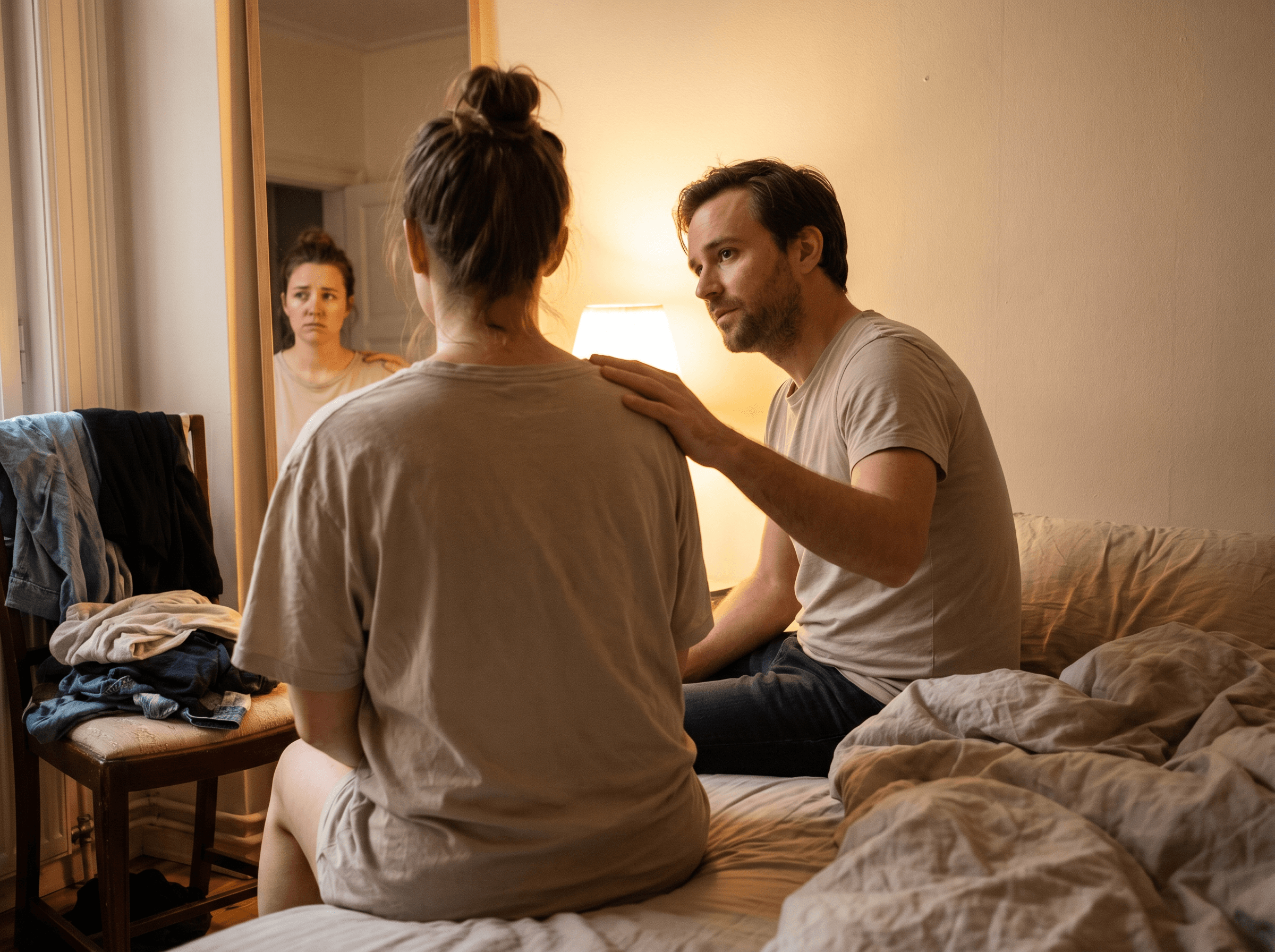
There are conversations couples have about intimacy — about frequency, about desire, about what is and is not working — and then there are the conversations they never quite manage to start. Body image sits in that second category for most people. It operates quietly, persistently, and often invisibly, shaping how someone shows up in a relationship without either partner fully understanding why. Body image issues do not announce themselves. They surface as avoidance, as distraction, as a reluctance to be seen that gets misread as disinterest. For the person experiencing them, the body becomes an obstacle between themselves and the intimacy they actually want. For their partner, the distance can feel personal when it is not. Understanding how body image affects a relationship is the first step toward closing that gap.
What Body Image Actually Means
Body image is not simply how a person looks. It is how they perceive, feel about, and relate to their own body — and that relationship is often entirely disconnected from physical reality. A person with a conventionally attractive body can carry a profoundly negative body image. A person whose body does not meet cultural standards can feel entirely at home in it. The subjective experience is what matters, and it is the subjective experience that affects behavior in a relationship.
Negative body image involves persistent dissatisfaction with the body, intrusive self-critical thoughts about physical appearance, and a tendency to evaluate one's worth through a physical lens. These are not vanity. They are a specific form of anxiety about the self — one that is particularly activated in contexts of physical exposure or vulnerability. Intimacy is, by definition, one of those contexts.
Body image issues develop through a complex mix of early experiences, cultural messaging, and personal history. The body absorbs a great deal — comments from childhood, media standards, experiences of comparison, moments of physical vulnerability that went badly. By the time these experiences surface in an adult relationship, they are rarely experienced as memories. They are experienced as the present: a feeling in the body, a flash of self-consciousness, an impulse to cover or hide or withdraw.
How Body Image Issues Affect Physical Intimacy
The most direct way body image affects a relationship is through physical intimacy. Sex and physical closeness require a degree of presence — of being genuinely in and with the body rather than observing it critically from the outside. Negative body image makes that presence very difficult.
The person struggling with body image may physically avoid situations of exposure. They keep the lights off, they avoid certain positions, resist being touched in areas they feel self-conscious about or stay clothed longer than feels natural. Each of these behaviors has a logic — they reduce the risk of exposure to perceived physical flaws. But each one also introduces a layer of distance into what is supposed to be a moment of closeness.
More insidiously, negative body image affects presence even when avoidance is not happening. A person who is mentally cataloguing their perceived physical flaws during sex is not present with their partner. They are elsewhere — monitoring, evaluating, bracing. Their partner may feel them absent without understanding why. The physical act is happening. The connection is not.
This disconnect affects the body in practical ways too. Anxiety activates the nervous system in ways that work directly against physical pleasure. Arousal requires a degree of safety and presence that chronic self-criticism actively undermines. People with significant body image issues often find physical intimacy less satisfying not because they are less interested, but because their own internal environment makes full presence nearly impossible.
The Invisible Strain on the Relationship
Body image issues do not stay confined to the bedroom. They move through a relationship in ways that are harder to trace but equally damaging.
A person with a negative body image often reads their partner's behavior through a distorted lens. A partner who seems distracted becomes evidence of diminished attraction. A comment about health or appearance — however well-intentioned — lands as confirmation of the worst fears. A decrease in sexual initiation gets interpreted as physical rejection rather than stress or fatigue. The body image anxiety generates a constant background noise of interpretation that colors everything.
This creates a particular strain for the partner who is not struggling with body image issues. They find themselves navigating a minefield they cannot fully see,discover that certain comments produce unexpected reactions, notice their partner withdrawing in contexts that feel safe to them. As a result, they begin to manage their behavior — choosing words carefully, avoiding certain topics, treading lightly around physical affection — without understanding why they are doing it. The relationship quietly contracts around the issue without either person having named it.
Over time, this dynamic affects the emotional intimacy of the relationship as well as the physical. When a significant part of one person's inner experience is off-limits — when the anxiety around body image is too shameful to name — the relationship loses access to a genuine portion of that person. They are present, but edited. The partner senses the editing without knowing its source.
What Partners of People With Body Image Issues Need to Know
If your partner struggles with body image, several things are worth understanding clearly.
Their body image is not about you. The self-critical voice a person carries about their body developed long before your relationship and does not reflect on your attractiveness to them or their desire for you. When they pull back physically, it is almost never a statement about how they feel about you. It is a statement about how they feel about themselves.
Your reassurance helps — and also has limits. Telling your partner that you find their body attractive is meaningful and worth doing consistently. But it rarely resolves body image issues on its own, because negative body image is not primarily a factual problem. It is an experiential one. The issue is not that the person lacks information about how their body is perceived. It is that they cannot fully receive or integrate that information due to the depth of the internal experience. Reassurance is valuable as a form of love. It is not a cure.
What helps more than reassurance is presence without pressure. Creating physical contexts where the person feels safe — where closeness does not automatically imply performance or evaluation — gradually builds the trust the body needs to relax. This is slow work. It moves at the pace of the nervous system, not the pace of intention.
How Body Image Issues Can Be Addressed
Body image issues respond to intervention. They are not permanent features of a person's relationship with their body. But they require genuine engagement, not simply willpower or positive thinking.
Individual therapy — particularly approaches that address the relationship between thought patterns and bodily experience — is one of the most effective routes. Working with a therapist who understands body image helps the person develop a different quality of relationship with their own body: less evaluative, less critical, more capable of presence. This work directly improves the capacity for physical intimacy without targeting sex itself.
Couples therapy can also help when body image issues are significantly affecting the relationship. A therapist provides the couple with a shared framework for understanding what is happening — why one partner pulls back, what the other experiences as a result, and how both people can navigate the dynamic with less confusion and less pain. Often, simply naming the issue in a supported context releases a significant amount of tension that has been building without language.
For the person struggling with body image, physical practices that build a more positive relationship with the body — exercise approached from a place of care rather than punishment, somatic work, practices that emphasize what the body can do rather than how it looks — also tend to help over time. The goal is not a perfect body image. The goal is a body image permissive enough to allow presence.
The Role of Culture in Body Image and Relationship Intimacy
It would be incomplete to discuss body image issues without acknowledging the cultural environment that generates them. The standards to which most people hold their bodies did not emerge from thin air. They reflect decades of media messaging, advertising, and cultural ideals that are narrow, frequently unrealistic, and almost always commercially motivated.
These standards affect bodies of all types — but they do not affect them equally. Research consistently shows that women carry disproportionately high rates of body image anxiety and that the pressure to meet physical ideals intensifies with age, reproductive experience, and cultural exposure. Men are increasingly affected too, particularly around muscularity standards that have intensified in recent decades.
A relationship that explicitly refuses these standards — that creates its own internal culture of acceptance rather than importing cultural ideals uncritically — gives both partners a better chance. This does not mean pretending standards do not exist. It means consciously choosing not to apply them to each other, and saying so out loud.
Conclusion
Body image issues are common, quietly powerful, and deeply underestimated in their effect on relationship intimacy. They shape how people show up, how present they can be, and how much of themselves they can offer to the person they love. Naming that effect — honestly, without shame — is the beginning of changing it.
The body each person brings to a relationship carries its own history. It has been evaluated, compared, and found wanting by standards that were never designed with intimacy in mind. In a relationship, the body deserves something different: the experience of being close to another person without performance, without monitoring, without the background anxiety of not being enough.
That experience — of being held gently, fully, as you actually are — is not a luxury. For many people, it is the most healing thing a relationship can offer. Body image improves, slowly but genuinely, in environments where the body feels safe. Building that environment together is one of the most quietly important things a couple can do.