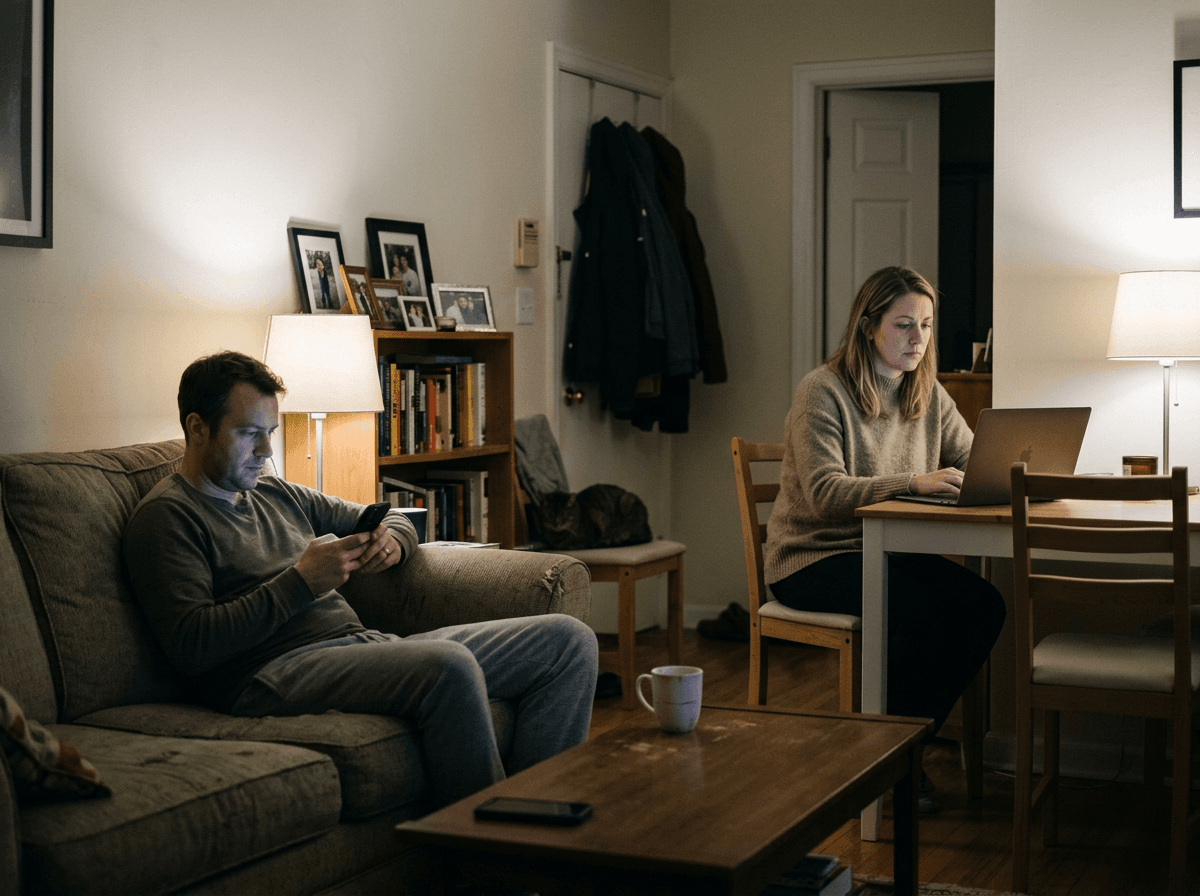
There is a particular kind of heartbreak that does not arrive with a single dramatic event. It accumulates. Two people who once chose each other with certainty gradually become strangers — sharing a home, a family, a daily routine, and very little else. The marriage continues. The connection does not. This is one of the most quietly devastating experiences a relationship can produce, and one of the least discussed precisely because it lacks the clean narrative of a crisis. Understanding how couples become strangers — and what prevents it — is work that matters long before the distance becomes irreversible.
How Strangers Are Made From Intimate Partners
The process by which a couple become strangers to each other is rarely dramatic in its early stages. It does not announce itself. It begins in small omissions — the conversation not pursued, the feeling not shared, the moment of connection offered and missed. Each instance is minor. The accumulation is not.
Researchers who study long-term marriage consistently find that emotional drift is the most common and least recognized threat to relationship health. Couples stop asking genuine questions. They stop sharing the inner life that changes over time — the fears, the ambitions, the private doubts that make a person who they are. Instead, they communicate around the logistics of shared life. The home gets managed. The children get raised. The marriage continues as an institution while the relationship inside it quietly empties.
What makes this process so difficult to interrupt is that it feels, at each individual stage, like nothing much is happening. The husband who stops sharing his inner world does not decide to become a stranger. He simply stops, gradually, offering the parts of himself that made genuine intimacy possible. His partner intuited something had shifted but could not name it precisely. By the time the distance became undeniable, it had years of momentum behind it.
The Role of Identity in Growing Apart
One dimension of couples becoming strangers that deserves more attention is the role of individual identity — specifically, what happens when one or both partners change significantly and the relationship does not adapt.
People change. Over the course of a long marriage, the person someone was at the beginning is not identical to who they become. Career, loss, parenthood, illness, and time all reshape identity in ways that are sometimes subtle and sometimes profound. A devoted father who barely recognizes his pre-children self. A steady partner whose ambitions quietly shifted over a decade. A woman who spent years as a compliant woman within her marriage, then reached a point — like an actor shrugging off a costume — where she could no longer inhabit that version of herself.
When a relationship does not create space for that kind of evolution — when growth becomes something one or both partners manage privately rather than share — the people inside the marriage begin to diverge. They become, in the deepest sense, strangers to each other's current selves. The person each partner relates to is a version of the other that no longer fully exists.
This divergence is not always visible from outside the marriage. From outside, the family looks intact. The home looks functional. The biography of the relationship reads as a success. Inside, two people are living parallel lives that intersect at the calendar and the dinner table and not much beyond.
What a Pandemic Revealed About Couples Living as Strangers
The pandemic brought an unexpected clarifying power to many marriages. Forced proximity removed the buffers — the commutes, the social events, the separations that allowed couples to coexist without genuinely engaging. For some marriages, the enforced closeness rekindled connection. For others, it revealed how far apart two people had drifted.
Many couples discovered, with stunning clarity, that the distance between them was structural rather than circumstantial. Removing the busyness did not produce closeness. It produced the recognition that closeness had been absent for a long time. The pandemic did not create strangers from these couples. It simply made the estrangement impossible to overlook.
Divorce rates shifted in the period that followed. Some couples, finally confronted with the reality of their relationship, chose to end it. Others recognized what had happened and determined to address it. The pandemic functioned, for many marriages, as a new lens through which the actual state of the relationship became visible — sometimes heartbreaking, sometimes clarifying, always honest.
The Memoir of a Marriage: What Honest Stories Tell Us
Some of the most compulsively readable accounts of marriage in recent years have been memoirs — deeply moving, built on unflinching honesty about what long-term partnership looks like from the inside. These books examine what biography rarely captures: the texture of daily life in a marriage, the slow erosion of intimacy, the moments of betrayal both large and small, and the profound grace required to face what a relationship has become.
What these memoirs consistently reveal is that the process of becoming strangers inside a marriage gets recognized, in hindsight, through accumulated detail rather than single events. A husband who grew increasingly discreet about his inner life. A partner whose voice in the relationship gradually diminished. A family that functioned as a unit while two people inside it lived with heartbreak they could not yet name.
These accounts carry real power not because they are exceptional but because they are familiar. They put language to an experience that many people carry privately, in marriages that look fine from the outside and feel hollow from within. The talent of the best memoir writers on this subject lies in their braver willingness to examines the relationship with unflinching honesty — and in doing so, to help readers recognize what they have been unable to name in their own lives. A good marriage memoir refuses to give up on truth, even when that truth is uncomfortable. It grips precisely because it is so deeply recognized.
What Prevents Two People From Becoming Strangers
Prevention is more available than most couples realize — and it does not require dramatic intervention. It requires care and consistent attention to the quality of connection, rather than just the functioning of the shared life.
The most effective prevention is also the simplest: genuine curiosity about who your partner is becoming. Not who they were, not what they do, but who they currently are — what they think about, what worries them, what they want from the years ahead. Long-term couples who remain genuinely interested in each other's inner lives do not became strangers. They continue to know each other.
Trust enables this kind of openness. A marriage in which both people feel safe enough to share what is actually true — including doubt, dissatisfaction, and change — is a marriage that adapts rather than drifts. Building and maintaining that safety is not a single act. It is a sustained practice of responding to vulnerability with care rather than dismissal.
Conflict, managed well, also prevents estrangement. Couples who address problems rather than manage them in silence stay more connected than those who maintain surface harmony at the cost of genuine engagement. A marriage that can hold difficult conversations is one where two people remain real to each other. The power of honest engagement — even when uncomfortable — is that it keeps both people visible to each other.
Strangers Are Not Made Overnight
The couples who become strangers in their own home did not set out to. Distance accumulated in the spaces left by missed connections, unasked questions, and growth that happened privately rather than together. Reversing that drift — or preventing it — does not require a crisis. It requires the same attention to the inner life of the relationship that was present, naturally, at the beginning.
A marriage that remains a genuine relationship is one in which both people continue to choose, actively and repeatedly, to know each other. That choice is made not in grand moments but in ordinary ones — in the question asked, the feeling shared, the moment of connection that could have been missed and was not. Love, expressed through sustained attention, is what keeps two people from becoming determined to live separate lives under the same roof.
The stranger across the dinner table was once the person you knew best. With enough care and attention, they can be again.