
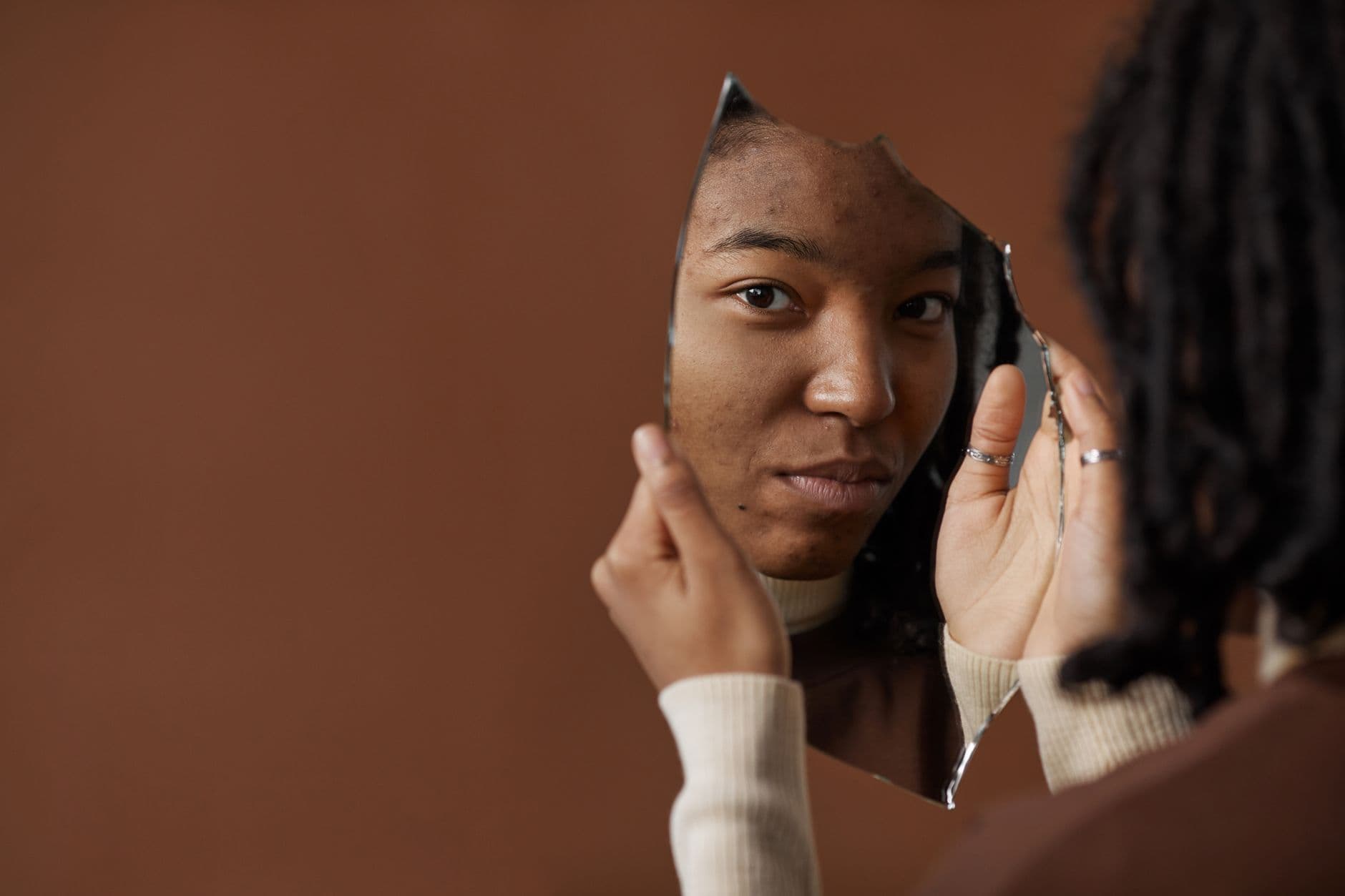
How well do you know yourself? Most of us would say: pretty well. The data says otherwise. We compared how 7,013 dating app users rated their own personality traits against what a structured psychological test showed for the same people. Only 13.8% got all three traits right within one point. For everyone else, the person in the mirror and the person in the test results were two different people.
I pulled these numbers from the SoulMatcher database expecting a modest gap. What I found was bigger, stranger, and in one case the exact opposite of what popular psychology had taught me to expect.
What we compared
Every SoulMatcher user rates themselves on three traits during onboarding: empathy, narcissism, and borderline tendencies, each on a 0 to 10 scale. It takes seconds. It is pure intuition.
Later, many of the same people take the structured PSY-ID assessment: a longer questionnaire that measures the same three traits and powers the app's compatibility matching. Same scales, same person, two very different instruments.
That gave us 7,013 people with both measurements on file. Put the quick self-rating next to the test result, and you get a portrait of human self-knowledge with a sample larger than most published studies on the topic.
One honest caveat before the numbers. A test is not "the truth" about a person; it is a second, more structured measurement. What we are really measuring is the gap between intuition and method. As you will see, that gap is wide.
Read also: How Well Do You Know Me Questions: Fun, Deep, and Conversation-Starters
The headline numbers
| Trait | Self-rating (avg) | Test result (avg) | Gap |
|---|---|---|---|
| Empathy | 7.13 | 6.92 | +0.20 |
| Narcissism | 4.32 | 3.89 | +0.43 |
| Borderline tendencies | 4.35 | 3.59 | +0.76 |
Three patterns stand out.
First, people rate themselves higher than the test does on every trait. Not just the flattering one. All three.
Second, the correlation between intuition and test is weak: 0.31 for empathy, 0.28 for narcissism, 0.36 for borderline tendencies. If you guessed someone's test score from their self-rating, you would barely beat a coin toss.
Third, the misses are not random noise. They follow demographic lines, and that is where it gets interesting.
Men think they are bigger narcissists than the test shows
Popular wisdom says narcissists never know they are narcissists. Our data shows the opposite problem, and it is concentrated in one group.
Read also: Why Am I Not Getting Matches on Dating Apps? 9 Reasons and What to Fix First
| Group | Self-rated narcissism | Test result | Gap |
|---|---|---|---|
| Women (n=3,708) | 4.17 | 4.05 | +0.12 |
| Men (n=3,290) | 4.49 | 3.72 | +0.77 |
Women's intuition about their own narcissism is close to what the test measures. Men overshoot by more than three quarters of a point: they call themselves more self-absorbed than the structured assessment finds them to be.
Across the whole sample, 32.2% of people overrated their narcissism by two or more points. Only 20.8% underrated it by the same margin. The stereotype of the oblivious narcissist exists, but in this dataset the louder story is people, mostly men, pinning a label on themselves that the test does not confirm.
My favourite detail: men also underrate their empathy more than women do. Put together, the male pattern reads like a systematically harsher self-image, not a kinder one.
The older we get, the more dramatic our self-image becomes
Borderline tendencies show the largest gap of the three traits, and the gap grows with every decade of age.
| Age group | Gap (self-rating minus test) |
|---|---|
| 18-24 (n=1,056) | +0.42 |
| 25-34 (n=2,380) | +0.50 |
| 35-44 (n=2,271) | +0.90 |
| 45+ (n=1,306) | +1.25 |
At 18 to 24, people overshoot their borderline score by less than half a point. After 45, the overshoot triples. Overall, 39% of users rated their borderline tendencies at least two points above their test result.
Read also: The Hidden Cost of Optimizing Your Dating Profile Too Much
I can only offer a hypothesis for why. By 45, most people have lived through a divorce, a breakup that left marks, or years of a difficult relationship. Those experiences become part of the story we tell about ourselves: "I am difficult, I am intense, I have baggage." The test, which asks about present behaviour rather than biography, disagrees. Our global divorce statistics show how common those marking experiences are; what this data adds is that they seem to echo in self-perception long after.
Empathy: the one thing people actually know about themselves

Here is the good news. On empathy, 57.9% of people landed within one point of their test result. The average gap is a fifth of a point, and people over 45 even underrate themselves slightly, by 0.09.
Empathy is also the trait we get the most feedback on. From childhood onward, people tell us when we listened well and when we did not. Nobody pulls you aside to say your borderline tendencies seemed elevated at dinner. The traits we are accurate about are the ones the world comments on.
That reading fits what personality researchers have found more broadly: Simine Vazire's work on self-knowledge showed that people judge their own internal traits reasonably well, while traits that live in behaviour are often clearer to observers (Vazire, 2010). And the classic Dunning-Kruger studies demonstrated how confidently people misjudge themselves in domains where feedback is scarce (Kruger & Dunning, 1999).
What this means if you are dating
A few practical conclusions fall straight out of the data.
Read also: Does Being Less Selective Get You More Matches? We Checked 2,006 Users
Your self-description is a rough draft, not a fact sheet. If only 13.8% of people can call all three of their own traits accurately, the "about me" answers we all write on dating profiles inherit that error. This is one reason over-polishing a dating profile backfires: you end up marketing a person who does not quite exist.
Structured beats intuitive. A test can be wrong about you too, but it is wrong less systematically than a three-second self-rating. That is the entire reason SoulMatcher matches on assessed profiles instead of self-descriptions, and why the PSY-DNA report exists for people who want the longer version.
Ask the people who know you. Since the traits others observe are the ones we misjudge most, a friend's honest answer is data you cannot generate alone. Our how well do you know me questions make that conversation easier to start, and less awkward than it sounds.
Do not read your own drama literally. If you are over 40 and convinced you are "too much" for a relationship, note that your demographic overshoots that exact self-judgement by more than a full point. The feeling of being difficult is real; the measured trait is usually smaller. People with pasts still show up in our success stories with reliable frequency.
More from SoulMatcher Research
Read also: Stepford Wife: The Psychology of Perfection and the Cost of Losing Yourself
The Economy of a Like: What 417,785 SoulMatcher Swipes Reveal About Matches and Conversations
Methodology
Sample: 7,013 SoulMatcher users who completed both a self-rating (three traits, 0 to 10, collected at onboarding) and the structured PSY-ID assessment measuring the same traits on the same scales. Data was aggregated on 24 August 2026.
All figures in this article are group-level aggregates. No individual records were accessed for writing, and no group smaller than 1,000 people is reported. Gender comparison covers 6,998 users who specified gender; age comparison covers 7,013 users grouped in four bands. Averages are arithmetic means; the median gaps are +1.0 for borderline tendencies and 0.0 for narcissism and empathy, which means the average gaps are not driven by a small tail of extreme cases for borderline, while for the other two traits roughly half of users sit above and half below their test score.
Correlations are Pearson's r between self-rating and test result: 0.36 (borderline), 0.28 (narcissism), 0.31 (empathy).
A note on interpretation: neither measurement is ground truth. The comparison quantifies how far quick self-perception diverges from a structured instrument, not who a person "really" is.
This article is informational. Trait names such as narcissism and borderline refer to personality tendencies measured on continuous scales, not to clinical conditions. Nothing here is a diagnosis or a substitute for consulting a psychologist, psychotherapist or other qualified specialist.
These articles are for information only. They are not a substitute for consulting a psychologist, psychotherapist or other qualified specialist.