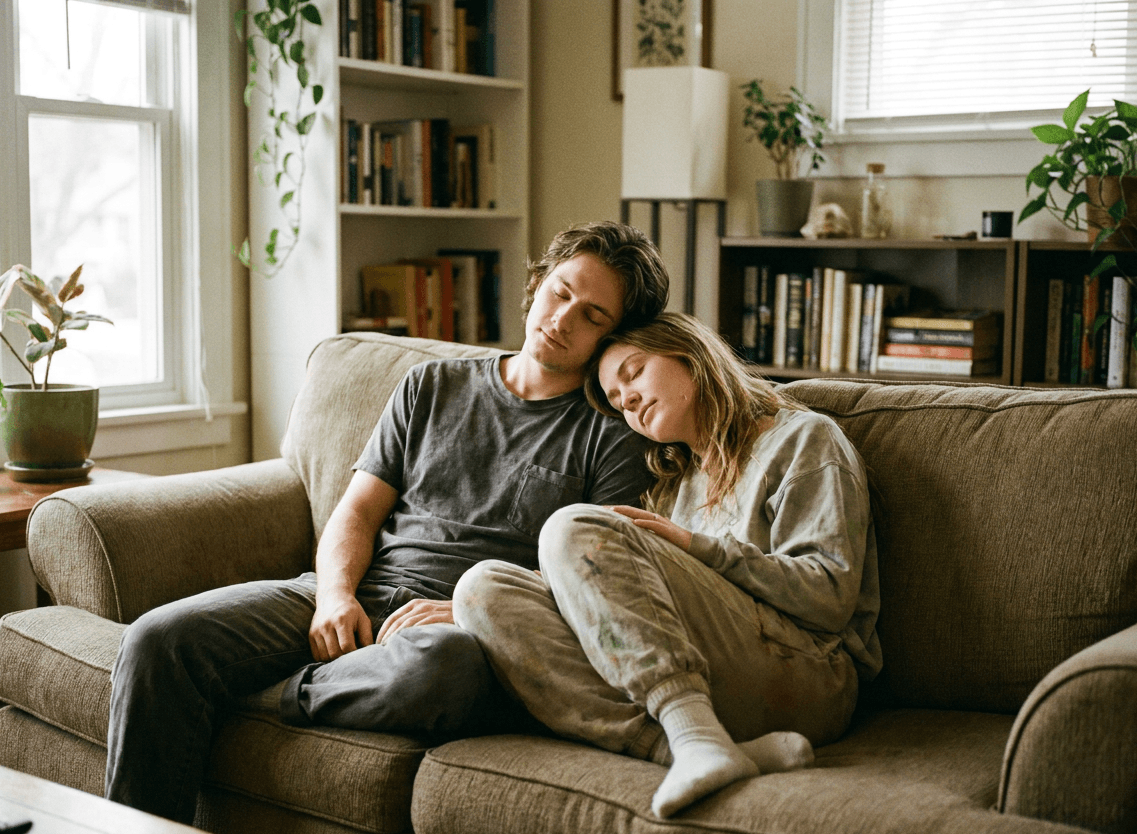
There used to be a particular quality to certain hours in a relationship. Not the hours organized around a plan or a task or a destination — but the ones that arrived without agenda and stayed that way. Sitting together without particular purpose. A long Sunday with nowhere specific to go. A conversation that wandered because there was time for wandering. The disappearance of idle time from modern relationships is not often named as a problem. It tends not to register as a loss. But something real goes with it — something that the scheduled, optimized, productivity-oriented version of shared life does not replace.
What Idle Time Actually Was
Idle time in a relationship was never simply the absence of activity. It was the presence of a specific quality of attention — loose, unhurried, available to whatever arrived. It created the conditions for things that did not happen on demand: unexpected conversations, genuine laughter at nothing in particular, the kind of comfortable silence that is itself a form of closeness.
For couples, idle time functioned as relational connective tissue. It provided the unstructured space in which two people discovered, repeatedly and without effort, that they simply enjoyed being in the same room. Not because they had planned an enjoyable activity. Because they were together, with time available and nowhere else to be.
This quality of time has a specific cost when it disappears. The relationship does not fall apart. It continues to function. But it functions differently — around a schedule rather than within a shared atmosphere. And the things idle time generated — the spontaneous, the unplanned, the gently revelatory — no longer have conditions in which to arise.
What Replaced It
The hours that idle time occupied are not empty in modern relationship life. They are full. They are full of phones, of streaming content, of the management of social media presence, of work that extended beyond work hours and never fully switched off, of productivity tools and to-do lists and the ambient noise of a life organized around optimization.
This fullness is not experienced as a problem because each individual element of it seems reasonable or even necessary. The phone is for keeping up with people. The show is for relaxing. The work email answered at 9pm is just handling one thing. Each micro-choice to fill time is locally justifiable. Their aggregate is the disappearance of the idle hours that once gave relationships their particular quality of ease.
The cost of this replacement is specific. Idle time cannot be reproduced by scheduling free time. "Free time" on a calendar is a category. Genuine idleness is a quality — of openness, of unhurriedness, of allowing the hour to take whatever shape it takes. The moment a couple schedules "quality time" in a way that carries implicit expectations of what that time should produce, it has already become something other than idle.
What Gets Lost With Idle Time
The things that idle time generated in relationships were not things that can be deliberately produced.
Spontaneous conversation is one of them. The conversations that reveal something new about a partner — that shift the relationship's internal landscape, even slightly — tend to arrive during unstructured hours when neither person is moving toward anything. In a fully scheduled life, those conversations rarely have the conditions they need. Conversations happen, but they tend to serve a purpose. They cover the agenda items of shared life rather than wandering into territory neither person anticipated.
Genuine rest together is another casualty. Rest in modern life tends to be consumptive rather than idle. Watching something, doing something, using something. The particular quality of two people resting in the same space without either consuming or producing is remarkably rare. It is also — for many couples — one of the things they remember most fondly about the early period of a relationship, before life accumulated its freight of obligation and schedule.
The idle hour was also the hour in which a couple's private culture formed — the jokes that require an origin story, the shared references, the particular texture of two people's time together that distinguishes their relationship from every other. That culture forms from accumulated unplanned moments. Planned activities contribute, but they contribute differently. The private language of a relationship grows in the gaps. When the gaps disappear, the language grows more slowly.
Why Modern Life Makes Idle Time Difficult
The disappearance of idle time from relationships is not primarily a failure of intention. Most couples would, if asked, say they value unstructured time together. The difficulty is structural.
Modern work does not reliably contain itself. Remote work, in particular, introduced the permanent availability of work into domestic space in a way that the commute once prevented. The physical separation between work and home was also, for many people, a temporal separation — a buffer between the professional and the relational that structured idle time by default. That buffer has largely eroded. Life at home increasingly coexists with the possibility of work, which means that even idle hours carry a low-level awareness of what could be done instead.
The attention economy compounds this. Every device in a modern home actively competes for the unstructured hour. The cost of picking up a phone during idle time is invisible in the moment. It is only visible in aggregate — in the gradual replacement of genuine couple idleness with parallel individual consumption in the same physical space. Two people in the same room, each attending to their own screen, is a form of being together. It is not the form that idle time once provided.
Social comparison also plays a role. The visibility of other people's curated, activity-filled social lives creates an implicit standard against which unstructured time can feel unproductive, wasteful, or insufficiently interesting. This is, in most cases, an illusion — but the pressure it creates is real enough to make sitting doing nothing together feel like something that requires justification.
What Protecting Idle Time Requires
Protecting idle time in a relationship requires understanding that it is not simply the absence of plans. It is an active choice against the default mode of modern life, which is perpetual availability and perpetual stimulation.
The practical implication is that idle time needs protecting rather than scheduling. Protecting means resisting the specific forces that fill it without the couple having consciously decided to fill it. Putting the phone in another room. Letting a streaming service wait. Not filling the gap before it has had a chance to become something.
The couples who maintain idle time most successfully tend to treat it as a relationship priority rather than a relationship luxury. They recognize the difference between time spent together and time spent together idly. They resist the cultural narrative that equates a couple's wellbeing with the quality and quantity of their planned activities. And they notice, when the idle hours return, that something they did not know they were missing is briefly available again.
Conclusion
The disappearance of idle time from modern relationships represents a specific and underappreciated cost. Not a dramatic one. Not one that appears on any list of relationship risks. But one that gradually changes the texture of shared life in ways that both people sense without always being able to name.
The idle hour cannot be reproduced by planning. It requires the removal of the things that replace it — and the willingness to let time be nothing for a while, together. That willingness is, increasingly, one of the more countercultural choices a couple can make. It is also one of the quieter forms of care available to a relationship that wants to remain genuinely alive.
The time is not wasted. It is, in many ways, the relationship itself.