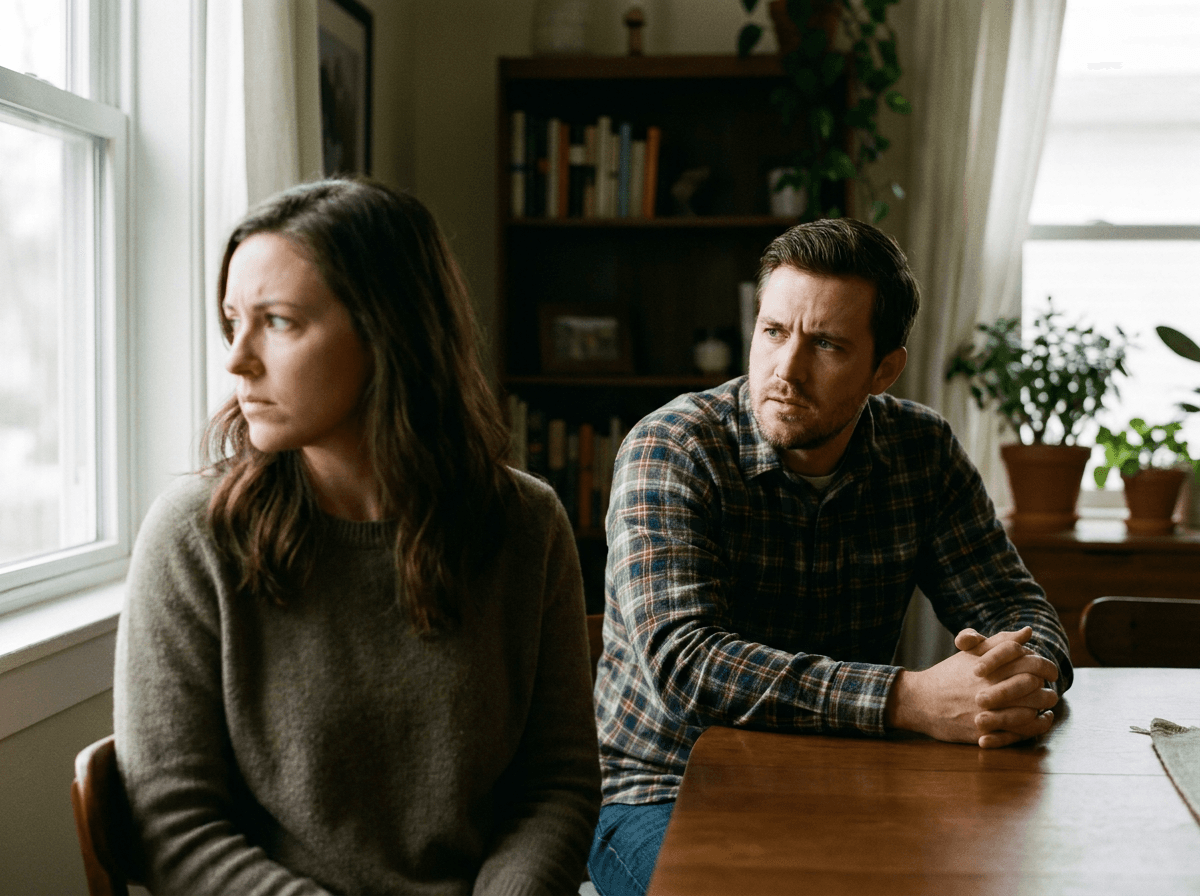
The couples who never fight are sometimes held up as a model. As evidence that two people have found a harmony that arguing couples lack. In reality, the complete absence of conflict in a relationship is more often a warning sign than a virtue. Chronic conflict avoiders — people who consistently sidestep disagreement, tension, or any exchange that might produce friction — are not experiencing harmony. They are experiencing suppression. And suppression, sustained over time, produces a specific kind of relational damage. Quiet, gradual, and often invisible until it is advanced.
What Conflict Avoidance Actually Looks Like
Conflict avoidance in relationships does not always look like obvious people pleasing or constant capitulation. It takes subtler forms that are easy to mistake for easygoing personalities or mature communication.
The conflict avoidant partner tends to change the subject when a difficult topic arises. They give vague answers to direct questions to avoid committing to a position that might produce disagreement. They say "it's fine" when it is not. Because the alternative feels more threatening than the discomfort of swallowing something genuine. They avoid bringing up concerns because they fear what raising them might do to the relationship. And so the concerns accumulate, unaddressed, beneath the surface of a relationship that appears functional.
What distinguishes conflict avoidance from healthy emotional regulation is intention. Someone who genuinely needs time to cool down before addressing a difficult topic, and who then returns to it, is not avoiding conflict. Someone who lets difficult topics pass indefinitely, who never revisits what they chose not to address in the moment, is avoiding conflict in a way that produces relational consequences.
Conflict avoidance also tends to be self-reinforcing. The longer a person avoids expressing a difficult feeling or concern, the larger the accumulated backlog becomes. And the more daunting the prospect of raising any of it feels. The avoidance that was meant to protect the relationship gradually makes the relationship harder to repair.
Why People Avoid Conflict in Relationships
People avoid conflict for reasons that are worth understanding rather than simply labeling as problematic. Most conflict avoidance is rooted in genuine fear — and the specific fears vary.
Some people fear the other person's emotional reaction. They grew up in environments where conflict produced explosive or frightening responses, and they learned that the safest path was to avoid triggering those responses at all. In their adult relationships, they carry this learned response even when the partner in front of them is not explosive or frightening. The avoidance is a conditioned response to a historical threat. Not an accurate reading of the current situation.
Some people fear abandonment. They believe, often without full conscious awareness, that expressing dissatisfaction or disagreement risks the relationship itself. That a partner who hears negative feedback, frustration, or unmet needs will leave. This fear can produce a form of conflict avoidance that looks like constant accommodation. Always agreeing, never complaining, presenting a version of themselves that never fights back.
Some people fear their own anger. They avoid conflict not because they fear the other person's reaction. But because they do not trust what they might say or feel if the conflict is allowed to develop. They suppress not to protect the relationship but to protect the other person and themselves from something they experience as dangerous to let out.
Understanding which of these fears is driving the avoidance helps clarify what would need to change for the pattern to shift.
What Conflict Avoidance Does to a Relationship Over Time
The specific damage that chronic conflict avoidance produces in a relationship is worth examining because it is so different from what most people expect.
Most people assume that the problem with not fighting is that disagreements go unresolved. This is true. But the deeper problem is what the avoidance does to connection and intimacy.
Genuine intimacy requires the knowledge that you are seen, that your partner knows who you actually are, including the parts that are difficult, frustrated, or dissatisfied. When one or both partners consistently avoid conflict, they avoid revealing those parts. The relationship that never fights is often a relationship in which both people are presenting an edited version of themselves. One that excludes the experiences, frustrations, and needs that might produce friction.
Over time, this editing produces the specific drift that conflict-avoidant couples are most at risk of. The relationship feels increasingly surface-level, even if both people are committed and caring. The sense that you are known by your partner, that you can be fully yourself in the relationship, quietly erodes. And the distance that results is not the sharp, dramatic distance of a bad fight. It is the slow, sad distance of two people who have stopped fully showing up.
This drift tends to be particularly difficult to address because it is invisible. There is no identifiable rupture to point to, no conflict to repair. The relationship simply becomes less alive over time. And neither person knows quite when or how that happened.
Why Couples Who Never Fight Are Not Necessarily Close
There is a persistent cultural narrative that equates the absence of conflict with the presence of harmony. Couples who never fight are assumed to agree on everything, or to have such mutual respect that friction never arises.
The research on relationship quality consistently challenges this. Relationship scholars identify three broad conflict styles in couples: volatile (frequent, intense disagreement), validating (regular, moderate conflict with good repair), and conflict avoidant (rare conflict, high surface harmony). All three can produce stable, long-term relationships. But the research also shows that conflict-avoidant couples tend to have less emotional intimacy than validating couples. And that the stability of conflict-avoidant relationships often depends on both people continuing to suppress. Which becomes harder to sustain as individual needs and the relationship evolve.
The couples who never fight are not necessarily the couples who never have anything to fight about. They are often the couples who have learned to not fight. The things that might have produced conflict get managed around, avoided, or absorbed. The relationship remains intact. But the emotional interior of the relationship narrows with each avoided conversation.
What Helps Conflict-Avoidant Couples
The shift from conflict avoidance to genuine engagement requires addressing both the behavior and the fears that drive it.
The most useful reframe is understanding conflict not as a threat to the relationship but as a tool for maintaining it. Couples who can internalize this, who understand that a difficult conversation is an act of investment in the relationship rather than a risk to it, tend to find the prospect of conflict less threatening.
Low-stakes practice helps. Conflict avoidant couples often benefit from starting with smaller, lower-stakes disagreements. Learning to tolerate the discomfort of genuine difference without immediately suppressing it. Before addressing the larger accumulated concerns.
Individual or couples therapy tends to be particularly effective for this pattern. A therapist can help identify the specific fears driving the avoidance. And can provide a structured, safe context in which both people can practice genuine engagement with difficult feelings and topics. For many conflict-avoidant couples, the therapeutic context is the first place they have ever had a genuine difficult conversation. And the experience of surviving it tends to reduce the fear significantly.
Conclusion
Conflict avoidance is not a neutral quality. In the short term, it keeps things smooth. In the long term, it tends to produce the quiet erosion of intimacy that chronic conflict avoiders are most at risk of — the gradual drift of two people who have been too careful with each other for too long.
The couples who fight well, who can raise difficult things, hear hard truths, and repair after genuine disagreement, tend to sustain more genuine closeness over time. Than those who maintain peace by avoiding the conversations that would disturb it.