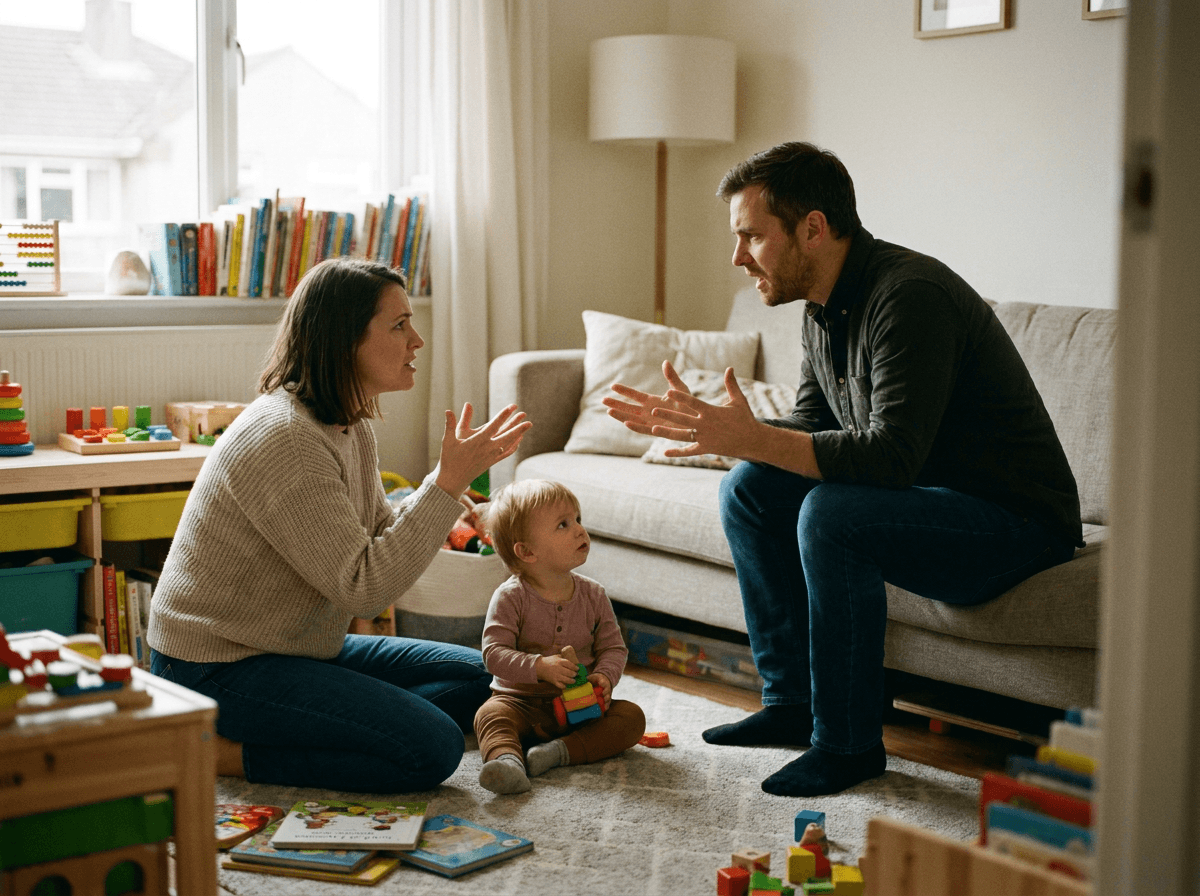
Couples often spend considerable time discussing whether to have children and very little time discussing how to raise them. The assumption — usually unspoken — is that they will figure it out together. What many couples discover — sometimes quite suddenly — is that they arrived at parenthood with fundamentally different instincts. About what good parenting looks like. Parenting style differences are one of the most consistently underestimated sources of relationship conflict in partnerships with children. They are also one of the most difficult to address. They sit at the intersection of deeply held values, formative personal history, and the daily practical reality of raising another human being.
What Parenting Styles Are and Where They Come From
Developmental psychology has identified four primary parenting styles, originally described by Diana Baumrind and later expanded by Maccoby and Martin. These are authoritative, authoritarian, permissive, and uninvolved.
The authoritative style combines warmth and structure. It involves high expectations alongside emotional responsiveness and explanation. The authoritarian style prioritizes obedience and discipline over emotional attunement — rules are to be followed, explanations are secondary. The permissive style is warm but low on structure — parents are responsive and nurturing but avoid setting firm limits. The uninvolved style offers minimal engagement in either direction.
Most people do not practice one style in pure form. They default toward a style shaped primarily by how they were parented. And then adjust in response to circumstances and their child's temperament. The critical point is that these defaults feel natural, obvious, and often morally correct to the person who holds them.
When two parents hold different defaults, what feels like common sense to one feels wrong — or even damaging — to the other. This is the core of the tension. This is the ground on which parenting style differences generate the most persistent conflict.
Why Parenting Differences Feel So Personal
Conflict between parents over parenting approaches is rarely experienced as a simple practical disagreement. It is almost always experienced as something more charged. As a judgment on one parent's values, their childhood, or their capacity as a parent.
This is partly because parenting instincts are so deeply rooted in personal history. The parent who defaults to a more authoritarian style often does so because that is how they were raised. Because they associate structure and discipline with love and respect. The parent who defaults to permissive parenting may associate structure with rigidity or control. And warmth with safety. Each position has a logic that feels self-evident from the inside.
When these positions clash, neither parent typically experiences the disagreement as a difference of style. They experience it as being undermined, contradicted, or judged by their supposed partner in this. The conflict that follows is often more about the felt judgment than about the specific parenting decision that triggered it.
Understanding this — that parenting style conflicts are almost always about more than the immediate issue — is the first step toward addressing them without escalation.
Common Conflict Scenarios in Parenting Style Differences
Several recurring scenarios illustrate how parenting style differences typically surface in relationships.
The most common is inconsistency between parents in the moment. One parent sets a limit; the other overrides it. One parent responds to a child's distress with comfort; the other responds with a directive to stop crying. These in-the-moment differences are visible to the child, confusing for the family system, and frequently produce conflict between parents.
A related scenario is the tendency of one parent to compensate for the other's style. The parent who sees their partner as too strict becomes more permissive than they would naturally be. To balance the dynamic. The parent who sees their partner as too soft becomes more rigid, for the same reason. Each move generates a counter-move. The parenting styles polarize rather than converge.
A third scenario involves extended family. When grandparents practice a style that one parent endorses and the other does not, the parenting disagreement gains a new dimension. Loyalty, criticism of one parent's family, and the implicit comparison between how each parent was raised.
How Parenting Style Differences Affect the Relationship Over Time
The relationship effects of sustained parenting style conflict are cumulative and often underappreciated. Parents who regularly disagree about parenting find that the conflict bleeds into other dimensions of the relationship. Especially when it happens in front of the children, through countermanding each other, or through persistent low-level tension.
Resentment accumulates. Each episode of disagreement carries the weight of previous ones. Parents may begin to feel that their fundamental values are incompatible. Not just their parenting approaches — but who they are as people. The relationship can start to feel like a permanent negotiation rather than a partnership.
Children are also affected in ways that loop back into the relationship. When children learn to play one parent against the other, the result is stress for both parents and additional friction between them. They invariably do this when parenting is inconsistent. The children are not behaving badly. They are responding rationally to an environment in which the rules change depending on who is in the room.
What Actually Helps: Moving Toward a Shared Approach
Parenting style differences in relationships rarely resolve through the victory of one approach over the other. The parent who "wins" the argument typically produces resentment rather than genuine alignment. What actually helps is the development of a shared parenting philosophy that both parents can genuinely endorse — not as a compromise that satisfies no one, but as a collaborative position that reflects both people's values.
This process requires the kind of conversation that most parents never have. Not the reactive argument after an incident. But a deliberate discussion about what each person values in parenting. Where their instincts come from. What they are trying to produce in their child. How they want to function as a parenting team.
Research on co-parenting consistently finds that relationships where parents feel genuinely aligned on parenting values show significantly lower levels of conflict. Even when they differ in specific approaches. Alignment matters more than uniformity. The alignment does not require identical styles. It requires mutual respect for what the other parent is trying to do and genuine agreement on the outcomes both are working toward.
Professional support — either through couples therapy or parenting-specific support — can be valuable for parents whose parenting style differences have become deeply entrenched. An outside perspective can help each parent see the other's approach with more curiosity and less judgment. This tends to reduce the felt threat that makes these conversations so difficult.
Conclusion
Parenting style differences are a normal feature of relationships where two people with different histories try to raise a child together. They become a serious source of conflict not because the differences exist. But because they are never addressed directly, never contextualized within a broader shared framework, and never decoupled from the personal history that makes them so charged.
Parents who approach their differences with genuine curiosity are in a considerably better position. Not "why does my partner do that wrong thing?" but "where does that instinct come from and what is it trying to achieve?" That shift changes everything. The goal is not uniformity. It is coherent partnership.