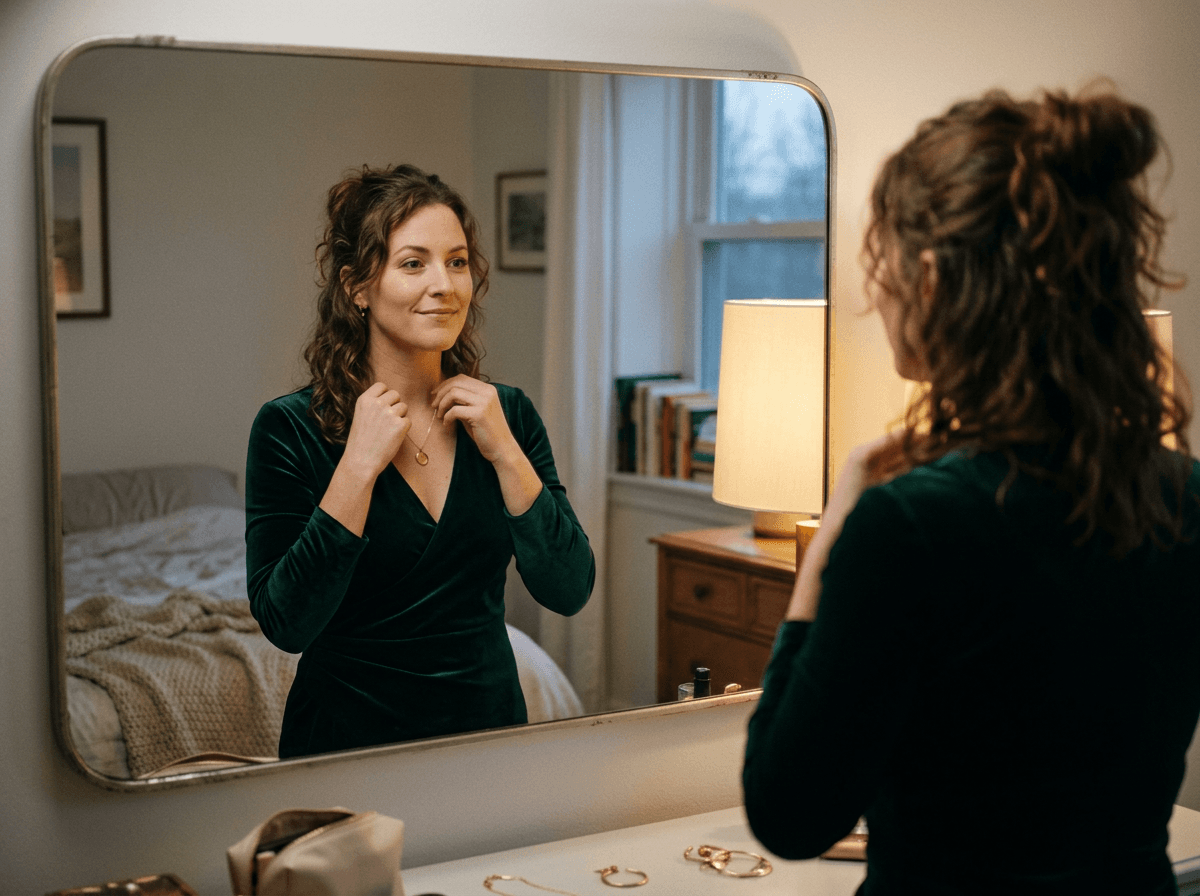
Getting dressed is a private act. It happens before anyone sees you. In a relationship, though, those quiet choices carry real relational meaning. How much effort a person invests in looking good for someone they love — and when that effort begins to fade — reflects the psychological state of the partnership. Understanding what dressing up communicates, and what its absence signals, offers a surprisingly clear window into how two people are actually doing.
What Dressing Up Communicates Without Words
Dressing up for a partner is a form of nonverbal communication. It says: you are worth the effort. It says: I still want to be seen by you. At its core, it signals ongoing investment in the relationship.
That communication operates below conscious awareness for most couples. Neither person typically thinks, "I dressed up to signal relational investment." They simply feel noticed or unnoticed, valued or taken for granted. The psychology of appearance connects directly to attachment — the need to feel that a partner continues to choose you.
Research in relationship psychology consistently shows that perceived effort matters. People who feel their partner makes an effort for them report higher relationship satisfaction. Dressing up is one of the most visible forms that effort takes.
The dynamic is also reciprocal. When one partner makes visible effort with their appearance, it tends to activate a mirroring response. Signs of care beget care. Couples that continue to show up for each other — even in ordinary domestic contexts — tend to maintain a higher baseline of mutual warmth.
The Psychology Behind the Effort
Why do people dress up for romantic partners? Several overlapping motivations drive the behaviour.
The most fundamental is desire. In the early stages of a relationship, the drive to attract a partner's attention generates significant effort around appearance. Dressing up extends the instinct to present the best possible version of yourself to someone you want.
Beyond attraction, dressing up also reflects self-respect. Making an effort communicates how you value yourself and the shared life you inhabit with your partner. A person who continues to dress with care in a long relationship maintains a signal of ongoing engagement — with themselves and with the partnership.
Ritual plays a role too. Getting dressed up for a partner marks an experience as significant. It creates a distinction between ordinary time and chosen, invested time. That distinction matters in long-term relationships. Without it, all time risks becoming interchangeable — and that sameness is a well-documented contributor to relational drift.
What Happens When Dressing Up Fades
The gradual fading of appearance effort is one of those signs that both partners notice but rarely name directly. Both tend to process it as a vague feeling — a sense that something has shifted — without identifying the source.
The most common trigger for stopping is comfort. Long-term relationships create space for full relaxation of self-presentation. Showing a partner your entirely unmanaged self carries genuine intimacy. That comfort has real value. It distinguishes an intimate relationship from a performance.
The problem arises when comfort tips into indifference. When a partner who once made visible effort stops entirely — not on occasional lazy evenings, but consistently — the relational message changes. Indifference to how you appear around someone signals that their attention is no longer something you are actively seeking.
That shift tends to be felt before anyone names it. A partner on the receiving end may not identify the change in appearance as the source of their unease. They simply feel less desired, less chosen. Over time, that feeling accumulates into a generalised sense of distance. Once entrenched, it becomes harder to locate and harder to address.
When Stopping Is Not a Warning Sign
Not every reduction in appearance effort signals relational decline. Context matters enormously.
Periods of significant stress — illness, professional difficulty, mental health challenges, early parenting — reduce the energy available for self-presentation. A partner who stops making effort during a genuinely depleted period responds to their circumstances. Distinguishing between situational reduction and a sustained pattern requires attention to the full emotional texture of the relationship.
Some couples also establish a genuinely casual domestic register early on. They reserve visible effort for chosen occasions. That shared approach differs fundamentally from one partner's unilateral withdrawal from effort that was previously mutual.
How Couples Can Use This Awareness Productively
The psychology of dressing up is most useful when it prompts honest reflection rather than accusation.
Noticing that you have stopped making effort is worth examining. Not from self-criticism, but from genuine curiosity. Is it comfort, or is it closer to indifference? Is this relationship still somewhere you want to be seen?
Noticing that a partner has stopped is also worth raising. Gently, and without framing it as an attack. Something like: "I've noticed we've both gotten pretty comfortable at home — I kind of miss when we used to make an effort for each other." Rather than assigning blame, that opens a conversation. It names something real without making it a confrontation.
The Intention Behind the Clothes
Looking good for someone is not primarily about appearance. It is about the ongoing act of choosing to be seen by a person you love. Dressing up for a partner signals that their gaze still matters. It says, in a way that requires no words, that you are still in pursuit of them.
Relationships where both people keep making that effort — in appearance and in the many other small acts that constitute a living partnership — tend to stay warmer and more connected over time. Comfort is valuable. Indifference is not the same thing. The couples who understand that distinction, and who keep showing up for each other even when no occasion demands it, tend to build something that lasts.