

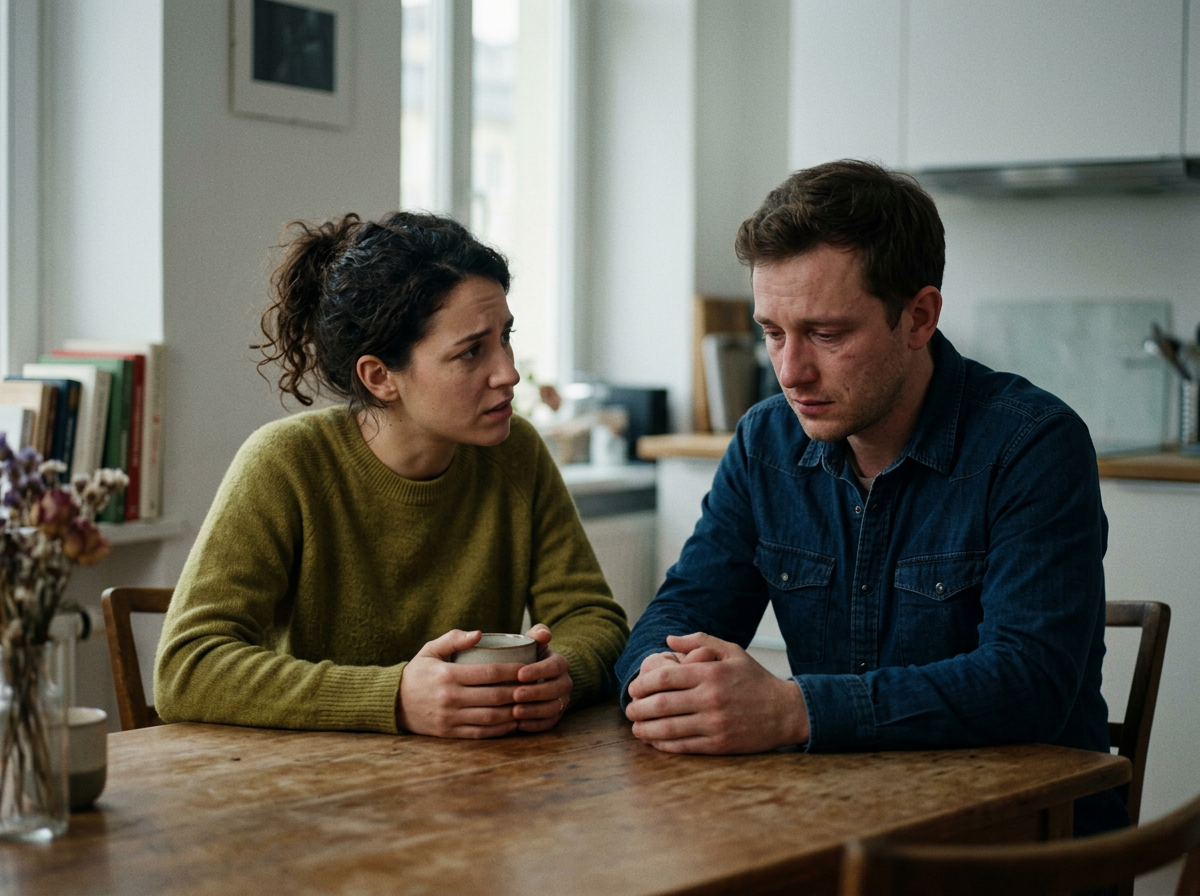
Most people approach relationships with a working assumption: that the future, while not guaranteed, is at least roughly imaginable. You can see, with some clarity, where things might go. Loving someone whose future is uncertain removes that assumption entirely. The partner facing a serious illness, an immigration question, a fragile career, or a mental health crisis cannot offer what most relationships quietly depend on. Staying — loving fully without the comfort of a clear horizon — is one of the most underexamined forms of courage that relationships ask of people.
What Uncertainty Actually Does to a Relationship
Uncertainty changes the texture of a relationship in ways that are difficult to prepare for. The shared plans, the imagined future, the conversations about what comes next — all of it loses its footing when someone's situation is genuinely unclear.
The relationship becomes present-tense in a way it was not before. Plans that would normally extend months or years compress into shorter windows. Conversations about the future require careful navigation — not because either person is unwilling, but because the future itself is not yet knowable. That compression can feel disorienting to both partners, even when both are fully committed.
For the partner whose future is uncertain, the experience carries its own particular weight. Alongside whatever they face — illness, instability, crisis — many carry a secondary anxiety. They become aware that they are asking something significant of someone they love. That awareness can generate guilt, withdrawal, or a complicated self-consciousness about what they feel able to ask for.
For the person loving someone through uncertainty, the challenge is different. It requires holding two things simultaneously: full presence in the current relationship and an open-handed acceptance of a future that most people find genuinely difficult to sit with.
The Specific Challenges of Loving Someone Through Uncertainty
Several challenges tend to emerge consistently for people in relationships marked by genuine uncertainty about the future.
The first is the suspension of shared planning. Relationships thrive partly on forward momentum — looking ahead, imagining, making decisions as a unit. When someone's future carries significant question marks, that planning either slows dramatically or takes on a fragility it did not previously carry. Both partners feel it.
The second challenge is managing the asymmetry of the uncertainty. One person lives inside the uncertainty as their primary reality. The other lives alongside it. Those are different experiences, and they can generate a particular kind of relational distance — not from lack of love, but from the difficulty of bridging two such different positions. The partner not facing the uncertainty directly may feel helpless or excluded. The partner living inside it may struggle to let someone in close enough.
The third challenge is the gradual accumulation of sacrifices. A relationship carrying significant uncertainty tends to require adjustments — in career plans, in geographic flexibility, in the emotional bandwidth available for ordinary needs. Those adjustments can feel manageable in the short term. Over an extended period, they accumulate into something heavier. Recognising that weight, and addressing it honestly rather than silently absorbing it, is essential to the relationship's long-term health.
What Staying Actually Requires
Loving someone whose future is uncertain requires several specific qualities that ordinary circumstances do not necessarily develop.
The first is genuine tolerance for not knowing. Most people have a higher tolerance for uncertainty in theory than in practice. Living daily alongside a partner whose situation may change in unpredictable ways is very different from accepting the unknown in the abstract. Developing that tolerance — not just intellectually but functionally — is its own form of growth.
The second quality is the ability to separate the present from an unknown future. A relationship that lives entirely in the shadow of what might happen loses the present tense. Someone who loves a partner through serious illness faces a choice: be fully present in the relationship as it currently is, or remain perpetually oriented toward a feared outcome. The first approach is more sustainable and more loving. It is also harder, because the feared future is real and cannot be entirely set aside.
The third quality is the willingness to have honest conversations. Both partners need to name what they need, what they can sustain, and what the relationship looks like from each position. Those conversations are uncomfortable. They require the person facing uncertainty to be honest about what they are going through. Equally, they require their partner to be honest about what they are carrying in support.
The Thing That Makes It Possible
What makes it possible to stay present in a relationship shadowed by uncertainty is not the elimination of fear. It is a decision — made deliberately, repeatedly — about what the relationship is worth relative to its difficulty.
That decision is not made once. It gets remade in ordinary moments of strain. In the moment when the sacrifices feel too heavy, when the absence of a clear future feels unbearable, when the easier choice would be to step back from the uncertainty by stepping back from the person.
People who stay through genuine uncertainty without bitterness tend to share a particular quality of intentionality. They are not staying because leaving feels unthinkable. They stay because they have decided, with clear eyes, that someone is worth what the situation asks. That distinction matters. Staying out of obligation generates resentment. Staying out of genuine, renewed choice generates something much closer to the relationship both people actually want.
What Loving Someone Through Uncertainty Builds
Relationships that survive sustained uncertainty tend to develop a quality that more comfortable circumstances rarely produce. The couple who has navigated genuine unknowing together — present with each other through difficulty that cannot be solved, only lived — builds a depth of trust and mutual knowledge that is hard to replicate any other way.
The partner who was seen fully during a period of uncertainty — whose vulnerability and fear and need were witnessed without withdrawal — carries that experience differently. Being truly known by someone who chose to stay, with full awareness of what staying involved, is one of the more profound things a relationship can offer.
Loving someone whose future is uncertain is hard in specific and practical ways. It asks for sacrifices that feel real because they are real. At the same time, it builds something equally real — a relationship shaped by conditions that reveal, without ambiguity, what each person is genuinely willing to give. That knowledge, once built, tends to hold.