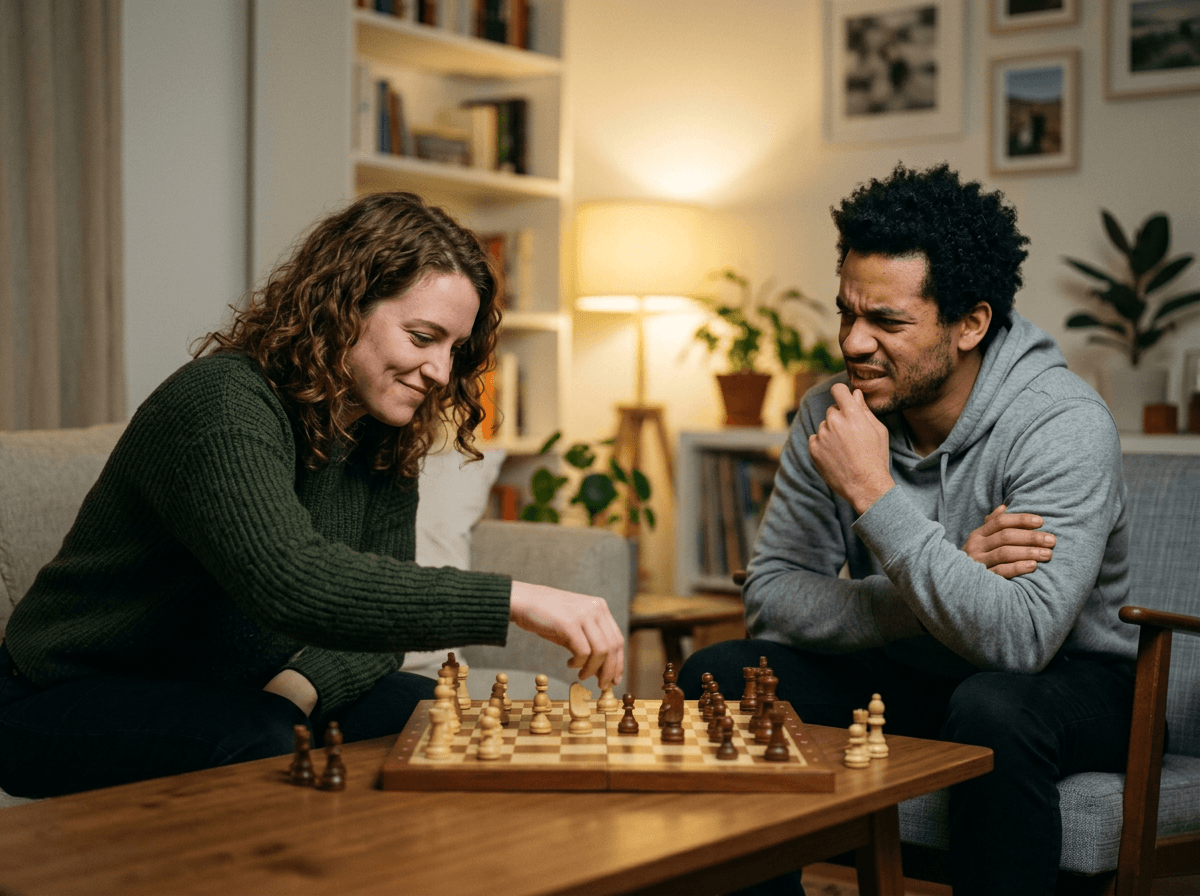
Competitive people make things happen. In sports, in business, in academic environments — the drive to excel and push past previous limits tends to produce results. That same competitive drive also travels into intimate relationships. Sometimes it sharpens a partnership. Sometimes it corrodes one. Understanding the psychology behind competitive personality traits — where they come from and how they express in love — helps both competitive people and their partners navigate what the dynamic actually involves.
The Psychology Behind Competitive Personality Traits
At its core, a competitive personality organises significant motivation around comparison. Where non-competitive people measure themselves against their own previous performance, competitive people measure themselves against others. Social status, relative achievement, and the experience of winning or losing register as core inputs to self-worth.
Biology plays a part. Research suggests that competitive drive has partial roots in temperament — some people respond more strongly to competitive stimuli from early on. Environment builds on that foundation. Families and academic or sports contexts that reward winning and attach approval to achievement tend to intensify competitive tendencies significantly.
The psychology behind extreme competitiveness also tends to involve anxiety. For many competitive people, the drive to win is less about the joy of success and more about the fear of falling behind. That fear generates resilience and sustained effort. It also generates chronic stress that follows competitive people into every domain they inhabit — including their intimate relationships.
What Competitive People Bring That Strengthens a Relationship
A competitive personality is not simply a liability in relationships. Competitive people bring genuine strengths that less driven partners may not offer in the same measure.
Motivation is one of the most consistent. Competitive people set personal goals and pursue them with sustained energy. In a relationship, that quality can generate real forward momentum — toward shared ambitions and toward improving the partnership itself. A competitive partner who turns that drive toward the relationship rather than against it can be a powerful force for growth.
Resilience is another. People with high competitive drive tend to manage stress and adversity with a persistence that serves a relationship well during difficult periods. The challenges that would flatten a less driven person tend to activate a competitive person's problem-solving mode.
Competitive people also tend to bring career ambition that creates stability and opportunity for a shared life. That energy, directed well, keeps a relationship dynamic rather than settled.
Where Competitive Personalities Create Problems in Relationships
The same qualities that make competitive people effective in business and sports create specific and consistent problems in intimate relationships.
The most fundamental issue is the habit of comparison. Unhealthy competitiveness in a relationship often appears as a drive to win within the partnership — to be right more often, to contribute more visibly, to be perceived as the more capable partner. That orientation treats the relationship as a competition rather than a collaboration. In that frame, a partner's success registers as a relative loss rather than a shared gain.
This dynamic tends to generate strained relationships over time. A partner who feels perpetually evaluated or outperformed eventually withdraws — emotionally, or from the relationship altogether. Competitiveness directed inward at a partnership is one of the more reliable ways to erode the safety that intimacy requires.
Competitive personalities also tend to struggle with vulnerability. For someone whose self-worth is tied to outperforming others, being less knowledgeable or less right than a partner in a given moment can trigger a disproportionate response. Arguments become about winning rather than resolving. Feedback becomes something to defeat rather than consider.
The anxiety underlying much competitive drive also costs relationships. Competitive people under stress tend to become less emotionally available. Partners of highly competitive people frequently describe feeling like they are competing for attention with their partner's ambitions.
Healthy vs Unhealthy Competitiveness in a Relationship
Not all competitiveness in a relationship operates the same way. Healthy competitiveness — the kind that generates playful challenge and mutual motivation — can genuinely strengthen a partnership. Competing together against the world is a very different dynamic from competing against each other.
The distinguishing factor is direction. When competitive energy flows outward — toward shared challenges and collective ambitions — it functions as motivation and shared drive. When it flows inward — toward establishing dominance within the relationship or winning arguments — it functions as a corrosive force.
Mindfulness is one of the more effective tools for competitive people trying to manage this. The ability to notice when the competitive reflex has activated in a relational context creates a pause. That pause makes a different response possible. It does not come naturally to most competitive people. It develops through practice — and often through watching their competitiveness damage something they value.
What Partners of Competitive People Need to Know
Living with a competitive personality requires specific understanding. Much of what reads as aggression or dismissiveness in a competitive partner reflects deep-seated anxiety rather than contempt. Recognising that changes the interpretation — and a different interpretation tends to produce a more effective response.
It also requires honesty about what each person needs. A partner who consistently yields to a competitive person's need to win does not protect the relationship. That pattern generates resentment and erodes authentic connection over time.
The competitive personality, for its part, benefits most from distinguishing between contexts where competitive drive serves them and contexts where it does not. A career rewards outperforming others. A relationship does not. Making that distinction — and practising it consistently — is the central psychological work that competitive people bring into their intimate lives. The partners who manage this well tend to stay curious about each other, honest about the effects of their patterns, and willing to keep adjusting. That willingness turns out to matter more than the competitive drive itself.