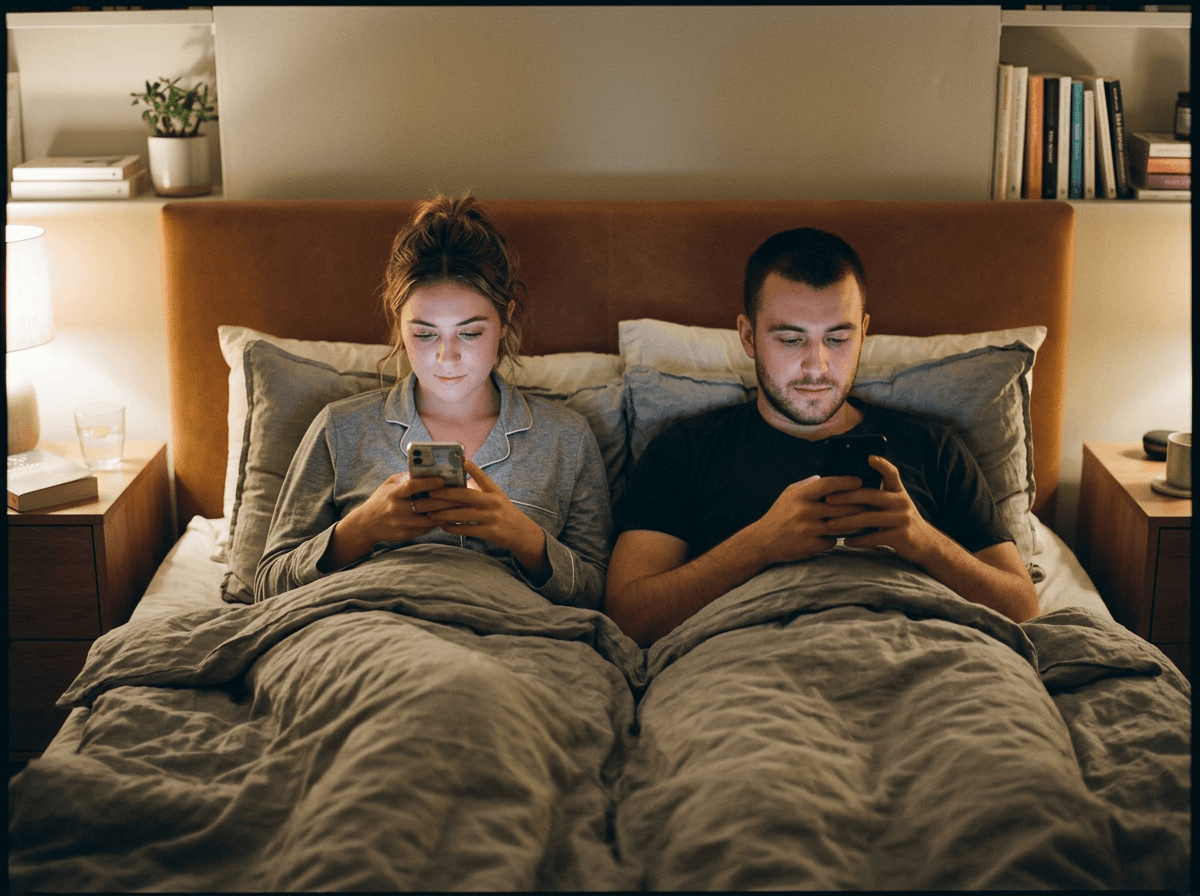
The bedroom used to be a private space. It belonged to sleep, to closeness, to the unguarded hours that couples share at the end of a day. For most people now, it also belongs to the phone. The scroll before sleep. The check first thing in the morning. The notification that pulls attention away at exactly the moment when the day has slowed enough for genuine connection to happen. Smartphones in bed have restructured one of the most intimate spaces two people share — and the cost to emotional and physical closeness is more significant than most couples realise.
What Phone Use in Bed Actually Displaces
The time between getting into bed and falling asleep is, for many couples, one of the few unstructured periods of the day. Work has ended. The logistics of the household are settled. The children are down. For a few minutes or longer, two people share a space with no particular agenda. Historically, that space held conversation, physical closeness, and the kind of low-stakes connection that sustains a relationship through everything else.
Phone use in bed replaces that space with parallel absorption. Both people are present but not to each other. They occupy the same physical environment while inhabiting entirely separate digital ones. The conversation that might have happened does not. The physical touch that might have been initiated does not begin. The transition from the day to genuine rest — with each other — gets bypassed in favour of content that generates stimulation rather than closeness.
The effect is cumulative. One evening of phone use in bed changes nothing. A year of it, as the default, quietly hollows out one of the more intimate parts of a shared life.
The Effect on Emotional Intimacy
Emotional intimacy does not survive on special occasions alone. It builds and maintains itself through small, repeated moments of genuine attention — and it erodes through their consistent absence.
The bed is one of the places where people let their guard down most naturally. The darkness, the physical proximity, the loosening that comes with tiredness — all of it creates conditions that are genuinely conducive to the kind of unguarded conversation that deepens connection. People say things in bed that they would not say at the dinner table. They surface worries, half-formed thoughts, small observations that would feel too trivial to raise in a more structured setting.
Smartphone use in bed disrupts that particular kind of openness. When one or both partners reach for the phone, the signal it sends — however unintentionally — is that what is on the screen carries more interest than what is in the room. Over time, partners stop offering those small, unguarded moments because experience has taught them that they are likely to compete with a device and lose. The emotional intimacy that those moments build gradually stops accruing. The relationship stays functional but loses depth.
The Effect on Physical Intimacy
The connection between smartphone use in bed and reduced physical intimacy is both direct and indirect.
The direct effect is simple. A person engaged with their phone is not engaged with their partner. Physical closeness requires attention and presence. It requires both people to be, at least partly, oriented toward each other. A bed divided by two separate screens is not a setting in which physical intimacy tends to spontaneously arise.
The indirect effect runs through sleep. Smartphone use before bed suppresses melatonin production through blue light exposure, delays the onset of sleep, and reduces sleep quality. Poor sleep affects mood, libido, emotional regulation, and the general capacity for warmth and connection. A couple who consistently use their phones in bed tend to be more tired, more irritable, and less emotionally available to each other — not just at night, but the following day as well.
There is also the effect of the content itself. Social media, news, and the broader smartphone content environment tend to generate arousal of the wrong kind — the stress-adjacent stimulation of outrage, comparison, and anxious engagement with the outside world. That is not a mental state conducive to physical closeness. The nervous system primed for the smartphone is not the nervous system that moves toward a partner with warmth and ease.
Why Changing the Habit Is Harder Than It Sounds
Most couples who recognise the problem with phones in bed find it harder to change than they anticipated. This is not a failure of motivation. It reflects the genuine difficulty of breaking a habit that is reinforced by some of the most sophisticated behavioural design ever created.
Smartphones and the platforms on them are engineered for engagement. The pull to check, to scroll, to respond is not accidental — it is the product of sustained effort to make the device as compelling as possible. Competing with that pull using nothing but good intentions tends to fail. What works better is changing the environment so that the pull does not get activated in the first place.
The most effective approach couples report is removing the smartphone from the bed and bedroom entirely. Not putting it face-down, not switching to silent — removing it. When the phone is not in the room, the habit has no trigger. The reflex to reach for it has nowhere to go, and the space it previously occupied gets filled with something else.
What Returns When Smartphones Leave the Bed
The changes that couples report after removing smartphones from the bed tend to be quick and significant. Conversation returns. Not always deep or meaningful — sometimes it is exactly the low-stakes, meandering kind — but it returns. Physical closeness increases. Sleep improves. The general quality of the time spent together in bed shifts from parallel absorption to genuine cohabitation of the same space.
Many couples also report a change in the feeling of the relationship more broadly. The bedroom becomes, again, a space that belongs to them rather than to the digital world. That reclamation is small in practical terms and significant in relational ones. It restores a boundary between the couple's private life and the external demands that the smartphone otherwise brings directly into the most intimate space they share.
A Simple Change With an Outsized Effect
The argument for removing phones from the bed is not that technology is inherently damaging or that constant connectivity has no value. It is more specific than that. It is that the bedroom is a space where the costs of smartphone use are unusually high and the benefits are unusually low.
Nothing of genuine consequence happens on a smartphone between midnight and seven in the morning that cannot wait. The conversations, the news, the content — none of it requires immediate access from bed. The relationship, by contrast, does benefit from that time. It benefits from the attention, the closeness, and the particular quality of connection that the late-night hours in bed have always offered — before the smartphone arrived and quietly claimed them.
The phone in bed is a small habit. Its effect on intimacy, accumulated over months and years, is not small at all. Removing it costs almost nothing. What comes back in its place tends to be worth considerably more than whatever was on the screen.